
Graphemes
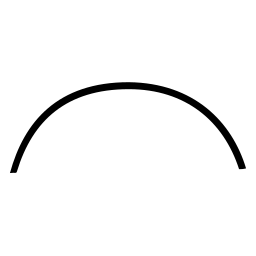
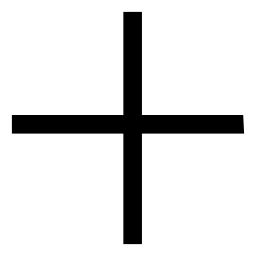
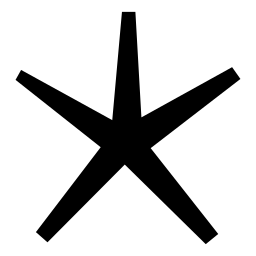
Graphemes are the basic shapes of visagrafía®. They are few, simple and stable: with fifteen graphemes the more than two thousand ideograms of the corpus have been written. Each one evokes a body part, a hand configuration or a feature of the sign's movement, and combined in an ideogram they describe the whole sign.
The fifteen graphemes
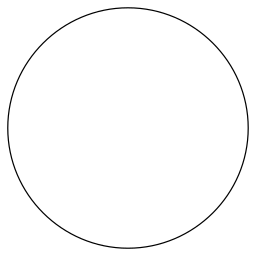
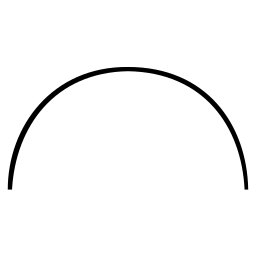
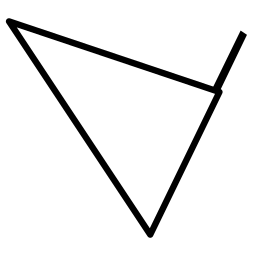
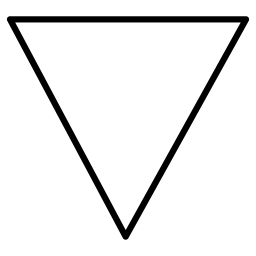
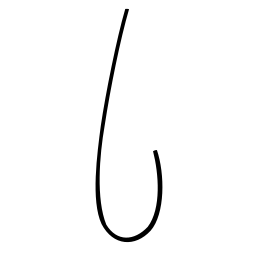

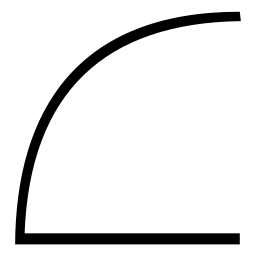
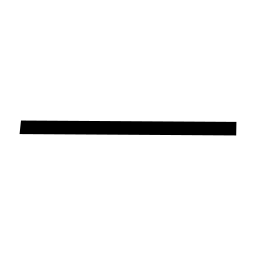
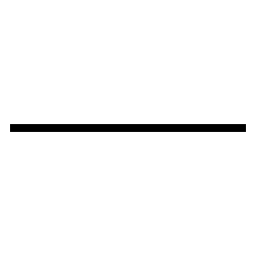



| Grapheme | What it usually evokes |
|---|---|
| Face | The face: the sign is produced near the face or the facial expression matters. |
| Shoulders | The torso and shoulders: the neutral space in front of the body. |
| Hand, Palm, Fist, Finger | Hand configurations: open hand, oriented palm, closed fist, one extended finger. |
| Cane | An arm or an elongated stroke; holding or leaning. |
| Moon, Curve, Line | Movement paths: a wide arc, a short curve, a straight displacement. |
| Circle, Dot | A circular movement or a place; a point of contact or of rest. |
| Cross, Plus, Asterisk | Modifiers: crossing or contact, addition or repetition, vibration or fast repetition. |
The name of every grapheme starts with a two-digit number (01 Cara, 08 Dedo). That number is the key the grapheme is picked with on the native keyboards and the order it appears in the palettes. Every grapheme can also have a localized name per language (Cara, Face, Visage, Rosto), which is what the palettes and tooltips show.
How a grapheme is defined
A grapheme is a vector drawing: one or more objects (polygons), each with its vertices and with segments that can be straight or Bézier curves. Each object has:
| Property | Meaning |
|---|---|
| name | A label to recognise it in the list of objects (circle 1, stroke 2). |
| x, y | Its position on the canvas. |
| scale x, scale y | Its size; a negative scale mirrors it. |
| rotation | Its turn. |
| stroke | The stroke thickness, in font units. |
| filled | With stroke 0 the object is drawn as a solid shape instead of a stroke. |
Objects are created from primitives (line, circle, ellipse, square, rectangle, triangle, rhombus, free polygon) and refined by moving vertices and control points. All of this happens in the grapheme editor.
Graphemes are shared
Graphemes belong to the collection, not to a locale: the same fifteen graphemes serve the ideograms in es_CO, en_US or any other locale of the collection. And since every ideogram references the grapheme instead of copying it:
- when a grapheme is edited and the new version is promoted to live, every ideogram using it changes at once;
- an ideogram can pin a specific version of a grapheme when it must not follow that evolution;
- when a grapheme is renamed, the editor says how many ideograms use it and updates the name in all of them.
Graphemes on the keyboards
Besides serving to draw, graphemes are a way to search. Whoever knows the sign but does not remember the gloss can point at the graphemes it is made of: the keyboards show the signs whose composition contains those graphemes, the closest matches first. The filter is a multiset: the same grapheme can be asked for twice to find the signs that use it twice. Graphemes that can no longer lead to any sign are dimmed.
To draw the palette offline, the font of every locale includes one glyph per grapheme in the Private Use Area (from U+F800). They are display glyphs: they are never written in a text.
Read on
- Ideograms: how graphemes combine.
- Grapheme editor: creating and modifying graphemes.
- Text editor: searching signs by graphemes.