
What is visagrafía®?
Visagrafía® is a writing system for sign languages. Sign languages are complete languages, with their own grammar and vocabulary, but they are produced with the hands, the face and the body, in space and in time, and so they have no natural writing inherited from a spoken language. Visagrafía® fills that gap with a simple principle: every sign is written with an ideogram, a graphic sign that sums up the visible features of the sign, and that ideogram is always composed from a small repertoire of basic shapes, the graphemes.
An ideographic system
In an alphabetic script each letter stands for a sound. In visagrafía® there are no sounds: each sign stands for a unit of meaning, the sign of the sign language. That is why we speak of ideograms rather than letters, and why a visagrafía® text is read sign by sign, the way a Chinese text is read character by character.
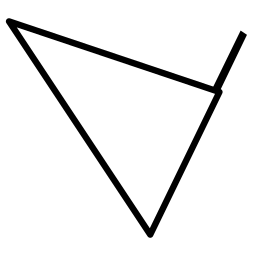
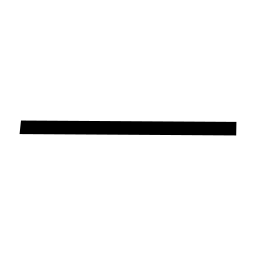
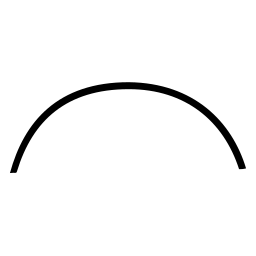
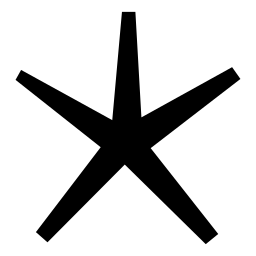
What visagrafía® does have, and what makes it learnable, is that ideograms are not arbitrary drawings. They are built by combining a few graphemes that evoke the body parts and the movements involved in the sign: the face, the shoulders, the open hand, the palm, the fist, one finger, a line of movement, a curve, a point of contact, an asterisk of repetition… Whoever knows the fifteen graphemes can read a new ideogram and get an idea of the sign it represents, just as whoever knows the radicals can guess at a Chinese character they have never seen.


How it is read and written
A visagrafía® text is a sequence of ideograms, left to right, with the usual spaces and punctuation. Each ideogram takes a square cell of the line, like a full-width character, and sits on a common baseline. Optionally, each ideogram carries its gloss underneath: the word of the spoken language the sign is named by (amigo, comer, hoy…). The gloss is not part of the writing, but it helps learners and makes the text readable by screen readers, which cannot pronounce an ideogram today.
Writing visagrafía® does not require drawing. It is typed:
- by writing the gloss on the keyboard and choosing the ideogram among the candidates (the way Chinese is typed with pinyin), or
- by pointing at the graphemes that make up the sign, when the sign is known but not the word.
The VisaSoft keyboards learn from use: they offer first the ideograms you use most and, after every ideogram, predict the next one.
Where it comes from
Visagrafía® was born as a notation system for Colombian Sign Language (LSC) and its first editor was VisaSoft 4.0, a Windows desktop program in which the graphemes and the more than two thousand ideograms of the reference corpus were drawn. That corpus, with its file formats (.grf for graphemes, .idg for ideograms), is the foundation of everything on this site.
VisaSoft Studio is the continuation of that program on the web: it keeps the corpus and its files intact, and adds what was missing for visagrafía® to become a script in real use: versions and snapshots, several locales per collection, TrueType font generation, a text editor that works as an input method, and native keyboards for Android and Windows.
The parts of the system
| Part | What it is | Where it is worked on |
|---|---|---|
| Grapheme | A basic vector shape, shared by the whole collection. | Grapheme editor |
| Ideogram | A composition of graphemes that writes a sign; exists per locale. | Ideogram editor |
| Collection | A set of graphemes and ideograms with their locales. | Collections |
| Locale | A language of glosses (es_CO, en_US…) inside a collection. | Collections |
| Font | The TrueType file that draws ideograms as text. | Font creation |
| Keyboard | The input method that turns words or graphemes into ideograms. | Text editor, Downloads |
How it is encoded: real text
A written ideogram is not a picture: it is a Unicode character. Every concept (every sign) has its own code point in Unicode's Private Use Area (from U+E000), assigned once and fixed forever. Thanks to that, visagrafía® text copies, pastes, saves into any file and travels across any network exactly like any other text, and shows wherever a visagrafía® font is installed. Where there is none, an empty box appears, never a wrong word.
Fonts come one per locale: the code point identifies the sign, and the font Visagrafia es_CO, Visagrafia en_US… draws that sign's ideogram for that locale. So several words in different languages can name the same sign, and one word can correspond to several signs, without the written text changing.
Read on
- Ideograms: how an ideogram is composed and encoded.
- Graphemes: the fifteen basic shapes, one by one.
- VisaSoft Studio: the online editor and how to get in.