
Ideograms
An ideogram is the written sign of a sign. It is the smallest unit visagrafía® is written with and, at the same time, a small composite drawing: several graphemes placed on a page, each in its position, with its size and its turn.
What an ideogram is made of
An ideogram is a list of grapheme references. Each reference says which grapheme it uses and how it places it:
| Property | Meaning |
|---|---|
| grapheme | Which of the collection's graphemes is drawn. The reference is stored by identity, so renaming a grapheme breaks no ideogram. |
| x, y | The position of the grapheme on the page, in font units. |
| scale x, scale y | The size relative to the original grapheme. A negative scale mirrors it. |
| rotation | The turn in degrees. |
| thickness × | A multiplier of the line thickness of the whole grapheme. |
| version | Normally the grapheme's live version; a specific version can be pinned so the ideogram does not change when the grapheme evolves. |
| rotation centre | Editor only: the point the reference turns around. |
An ideogram may also have strokes of its own (polygons drawn directly), although in the reference corpus every one is built from graphemes only. The order of the references is the drawing order.
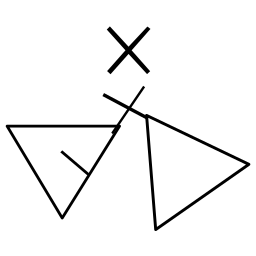
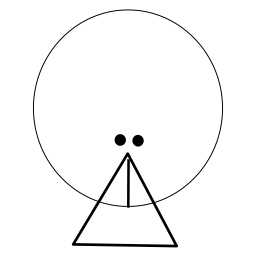
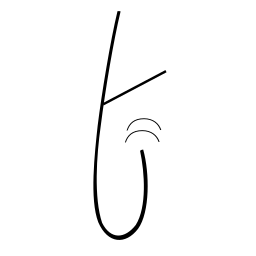
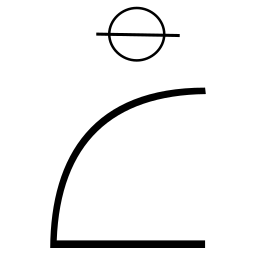
For instance, the ideogram for Colombia above is composed of a Circle crossed by a Line, an Asterisk and a large Moon: the reference to a place, the hand shape and the movement.
Ideograms, concepts and words
Each ideogram writes a concept: a sign. The concept is the interlingual unit; words are its names in each spoken language:
- A concept has one gloss per locale. In the
es_COlocale the sign meaning "friend" is called amigo; inen_USit would be called friend. The ideogram is the same. - One word can name several signs (homonyms); one sign can have several words (synonyms). This is resolved on the keyboard, when the candidate is chosen, not in the writing.
- The reference corpus holds 2,141 ideograms in the
es_COlocale.
In VisaSoft Studio ideograms are organised in collections and, inside each collection, by locale: the VisaSoft 4.0 collection has the es_CO locale; a collection can have several locales, each with its own set of ideograms, sharing the graphemes.
The glyph page
Every ideogram is drawn on the same page: a square of 1,000 × 1,000 units that coincides exactly with the font's em square. The bottom-left corner is the font origin; the baseline sits 200 units above the bottom edge, so the page runs from −200 to 800 vertically, with 20 % reserved for what hangs below the line, and from 0 to 1,000 horizontally.
This convention is what makes an ideogram behave like a character:
- one canvas unit is one font unit: what fills the whole page is drawn at the text's body height;
- every ideogram of the collection starts at x = 0, so they share the same left margin and line up;
- what sticks out of the page is still drawn, but it invades the next line or the neighbouring character.
The details and their consequences for the font are in Font creation. To see at a glance how big the ideograms of a collection are, the editor can draw percentile frames: the 50 % frame is the rectangle the smaller half of the ideograms fits in.
The ideogram as a character
When the font is generated, every concept becomes a glyph tied to its Private Use Area code point (U+E000 onwards, in the order of the original dictionary and fixed forever). Ideograms are drawn from their vectors: strokes become filled outlines, are merged and written as TrueType contours. The result is that typing the ideogram for amigo is typing one character, and a text file with a thousand ideograms weighs what a thousand characters weigh.
Graphemes get a glyph too (from U+F800), but only to be shown in the keyboards' palettes: they are never part of a text.
Seeing and editing ideograms
- Browse the corpus ideograms in VisaSoft Studio: open the collection, search by word (the search ignores accents) and click any of them to see it in the editor.
- Learn to create and modify them in the ideogram editor.
- Write with them in the text editor or with the keyboards.